
How to read London rental headlines: four measures to keep separate
Two property reports can appear to disagree while both accurately describe their own evidence. One may track new listings, another existing tenancies, and a third a narrow prime-market sample. The first step is to identify what each number measures.
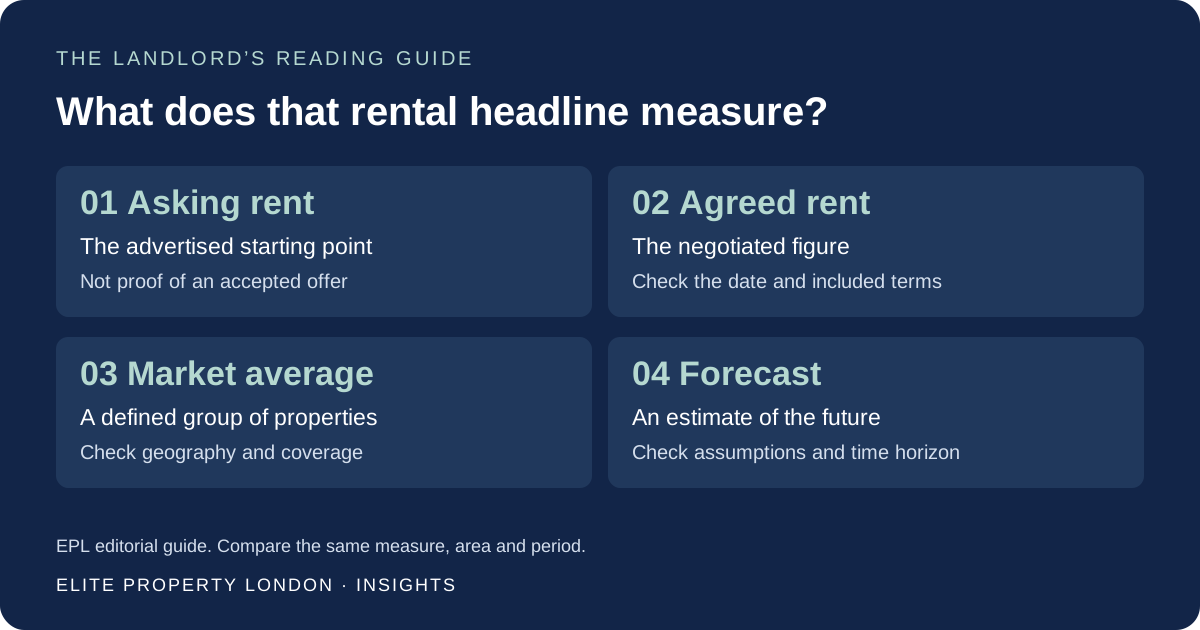
For London landlords, four distinctions make market commentary easier to use. The infographic summarises them; the sections below explain what to ask before applying a headline to your property.
1. Asking rent: the advertised starting point
An asking rent tells you what is being sought. It does not prove that an occupier accepted that figure. When reviewing listings, note when each advert appeared, whether its price changed and what is included. A furnished home with bills included is not directly comparable with an unfurnished home where the occupier pays those bills separately.
Save the details behind a comparable, not just the headline price. Photographs, floor area, condition and exact location can explain why apparently similar homes are advertised at different levels.
2. Agreed rent: the negotiated figure
An agreed rent is closer to the outcome of a particular negotiation. It still needs context: the agreement date, duration, included services and any incentives. Do not assume that an agreed figure is evidence of rent actually collected over the whole term.
When someone supplies comparable evidence, ask whether the figures are advertised or agreed and how recently the agreements were made. A smaller set of well-matched examples may be more useful than a large collection of loosely similar listings.
3. Market average: a view of a defined group
An average summarises a group of properties. It is not an appraisal of a specific home. The ONS private-rent index covers new and existing tenancies, so it answers a broader question than a collection of newly advertised listings.
Always look for the area, property types, sample and reference period. A London-wide figure and an agency’s prime central London index need not move at the same speed. Changing the mix of properties in a sample can also change an average, which is why methodology matters.
4. Forecast: an estimate of what may happen
A forecast looks forward using stated assumptions. Read its time horizon and conditions before applying it to a decision. A multi-year forecast is not a promise of the same increase in every year, neighbourhood or property.
For example, Savills’ rental outlook covers 2027–2031 and discusses affordability alongside demand. That is a different exercise from reporting the rent already agreed on a neighbouring flat.
A practical way to compare two reports
- Write down the source and publication date.
- Identify the reference month or forecast period.
- Check the geography and property types covered.
- Label the figure: asking, agreed, average, index or forecast.
- Compare like-for-like measures before drawing a conclusion.
If two sources disagree, keep both labels visible instead of averaging the numbers together. The difference may reveal that they cover different parts of the market. If the methodology is unclear, treat the comparison as incomplete.
Bring the evidence back to the proposed arrangement
For a company let, ask for a property-specific proposal that makes the rent, term, intended use and responsibilities clear. Compare those terms alongside relevant local evidence. Market commentary can help frame the conversation, while the written proposal explains what is actually being offered.