
London short lets: the 90-night rule and the register expected in 2027
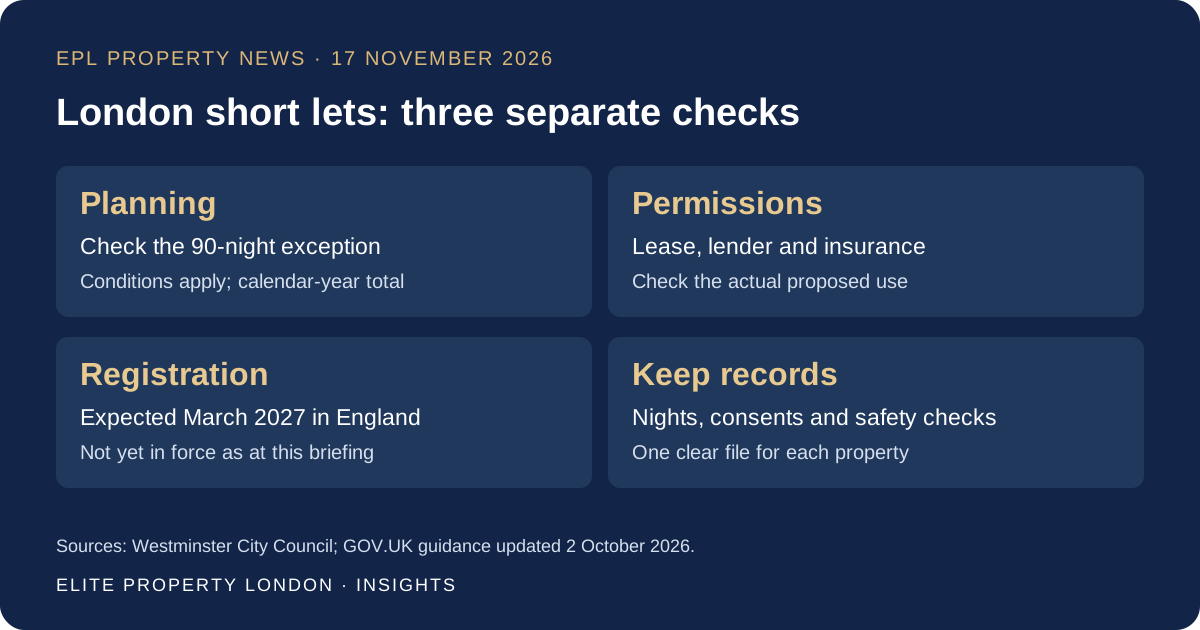
Short-let headlines often combine planning, registration and property permissions into one story. For a London owner, they are separate questions. A future registration scheme does not answer whether a particular home can lawfully be used for short stays today.
The London planning position comes first
Westminster’s guidance explains that qualifying short letting can take place for up to 90 nights in a calendar year without a planning application under the London exception. The conditions include the council-tax position. Letting beyond that allowance requires planning permission; confirm the position for the property with its local planning authority.
The calendar year runs from 1 January to 31 December. Keep one property-level record covering all booking channels rather than treating each platform’s count as a separate allowance.
What is changing nationally?
GOV.UK guidance updated on 2 October 2026 says England’s mandatory short-term-let registration scheme is expected to begin in March 2027. It expressly labels registration as not yet in force. That wording matters: an expected start month is not the same as a confirmed registration deadline for an individual property.
When further implementation details are published, owners will need to check the scheme’s scope, commencement and application process. Keep the registration question separate from the property’s existing planning position.
Planning is only one part of the permission check
Westminster also directs owners to consider their lease and permissions or notifications involving their freeholder, mortgage provider, insurer or landlord. Being within the nightly allowance does not establish that every contractual permission is in place.
Describe the proposed use accurately when making enquiries. Include who will operate the property and the nature of the stays. Keep written responses with the relevant agreement so the basis of the arrangement can be understood later.
Safety and operating records still matter
The government’s holiday-let guidance brings together fire, gas and electrical safety, EPC and insurance information. Requirements depend on the property and use; use the linked official guidance and appropriate competent advisers to establish what applies.
- Keep a consolidated record of nights and bookings.
- Locate the planning decision or evidence supporting the current planning position.
- Check the lease and any required lender, insurer or superior-landlord permissions.
- Keep applicable safety records and unresolved actions together.
- Check new registration announcements against the official implementation guidance.
Illustrative example
Worked example: bookings across three channels
Illustration only, not an EPL client case. Assume the same London property has completed 42 qualifying short-let nights through one platform, 28 through another and 15 through direct bookings in the same calendar year, with no overlapping nights.
- Completed nights across all channels
- 42 + 28 + 15
- Combined property total
- 85 nights
- Proposed next booking
- +7 nights
- Total if that booking proceeds
- 92 nights
The proposed booking would take this example beyond 90 nights. A platform showing fewer than 90 does not settle the property’s planning position. Even the initial 85-night total is not proof of compliance: the exception’s conditions, permissions and any planning restrictions still need checking.
EPL’s view: decide the use before comparing the income
An attractive projected income is not a substitute for a workable property arrangement. Begin with the permitted use, the parties and their responsibilities. Then compare realistic proposals on that basis. A company let and a holiday-let operation should not be treated as interchangeable simply because both involve furnished accommodation.
Checked on 17 November 2026. This article concerns London planning and the announced English registration scheme. Seek property-specific planning and legal advice where the position is unclear.