
Renters’ Rights in November 2026: what is in force and what comes next
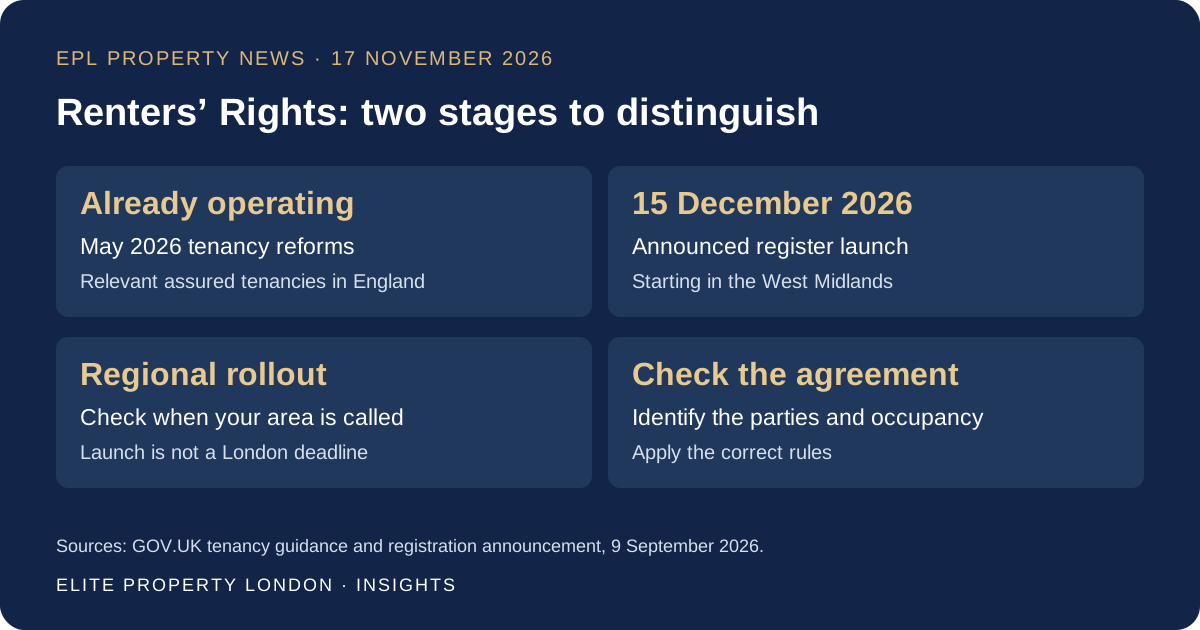
Renters’ Rights is no longer only a discussion about future reform. Major tenancy changes are already operating in England, while further measures have their own rollout dates. For London landlords, keeping those two stages separate is essential.
The tenancy changes already operating
Most existing assured shorthold tenancies became assured periodic tenancies on 1 May 2026. The reforms abolished section 21 for the new system; transitional rules can affect older notices and proceedings. These changes concern the relevant assured tenancy regime, not every arrangement described casually as a rental.
Government guidance says rent increases for assured periodic tenancies are limited to once a year, cannot take effect in the first 12 months of a new tenancy, and require Form 4A with at least two months’ notice. A proposed increase can be challenged. Do not rely on an old rent-review clause without checking the applicable process.
The next stage: an announced regional register rollout
The government’s September announcement says the landlord registration service will launch on 15 December 2026, beginning in the West Midlands. Regions will be called forward over 12 months, with a three-month sign-up period when an area is called. The announcement gives 14 November 2027 as the date by which all landlords actively letting property must have registered.
These are announced rollout arrangements. The launch date is not a universal London registration deadline. The announcement also distinguishes initial registration of occupied properties from future requirements concerning unoccupied properties and advertising.
What should a London landlord organise now?
Start with the information that makes the position of each property clear: who owns it, who is named in the agreement, who occupies it and the dates of relevant documents. Keep contact details and property records consistent across your files.
- Identify the legal tenancy or occupancy arrangement before applying a checklist.
- Check that current documents reflect the rules applicable to that arrangement.
- Keep rent notices, service records and correspondence together.
- Check official regional rollout guidance before treating any date as your registration deadline.
Illustrative example
Illustrative scenario: two properties, two regional checks
An owner has one occupied rental property in London and another in the West Midlands. They see the announced 15 December launch and assume both have the same deadline. This is a fictional scenario, not an EPL client case.
- Identify each property’s region
- 1
- Check its official call-forward date
- 2
- Record the applicable sign-up window
- 3
- Keep evidence of completion
- 4
The announced rollout begins in the West Midlands. A national launch headline alone does not establish the deadline for a London property. Check current official regional instructions and the scope of the requirement before acting.
EPL’s view: clear records are part of good management
The practical challenge is not simply learning a new set of terms. It is making sure the right process is used for the right agreement. A company-let proposal should identify the contracting parties and intended use clearly. Its legal treatment needs to be assessed from the actual arrangement, rather than assumed from its title.
Owners considering a change of arrangement should resolve questions about permissions, existing occupation and contractual responsibilities before committing. For possession, rent increases or uncertainty about which regime applies, obtain property-specific legal advice.
England only. Sources checked on 17 November 2026. This is an overview of published reforms and announced next steps, not advice on an individual tenancy or notice.